

.png)

Truck mileage charge 2026
Kilometer charge for trucks in the Netherlands from July 1, 2026
From July 1, 2026, the Netherlands will introduce a kilometer charge for trucks. This means that all trucks with a technically permitted maximum mass of more than 3,500 kg (categories N2 and N3) will pay per kilometer driven on almost all highways and a number of provincial and municipal roads.
What is changing?
- Eurovignette to be abolished: The current Eurovignette will be abolished in the Netherlands on July 1, 2026. However, it will remain mandatory in Luxembourg, Denmark, and Sweden.
- Motor vehicle tax reduction: The motor vehicle tax will be completely abolished for trucks up to 12 tons. For heavier vehicles, it will be reduced to the European minimum.
- Rates per kilometer: The rate depends on the weight, emission class, and VECTO class of the vehicle.
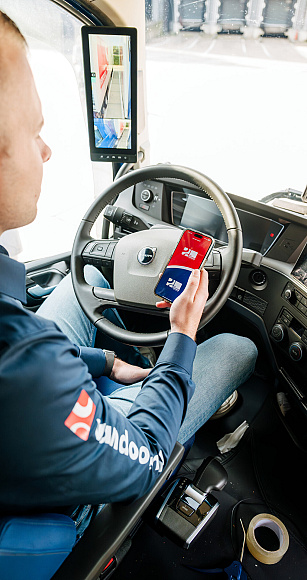
- On-board unit (OBU) mandatory: Every truck must have a working toll box to record kilometers.

CO2 Emission Class
The emission class indicates how many harmful substances a vehicle emits. The higher the emission class, the cleaner the vehicle. This classification not only determines whether the vehicle has access to environmental zones, but also plays a role in tax regulations. Heavy trucks are also subject to a CO₂ emission class. This class determines the amount of motor vehicle tax and, from July 1, 2026, also the rate of the kilometer charge.
The CO₂ emission class can be traced via the RDW's license plate check.
- Look under & #x27;Engine and environment&#
What is VECTO and why is it important?
VECTO stands for Vehicle Energy Consumption Calculation Tool. This is a European standard that calculates the fuel consumption and CO₂ emissions of trucks. Based on this calculation, each truck is assigned a VECTO class.
- How does it work? Manufacturers submit VECTO data to the RDW, after which the class is determined.
- Why is it relevant? The lower the CO₂ emissions, the more favorable the VECTO class and the lower the rate per kilometer.
- Classification: Trucks are classified into classes based on efficiency. A fuel-efficient truck (low VECTO value) pays less per kilometer than a less efficient truck.


How does it work?
CO2 emission class 1
| Technical maximum mass (kg) | EURO 0 | EURO 1 | EURO 2 | EURO 3 | EURO 4 | EURO 5 | EURO 6 |
|---|---|---|---|---|---|---|---|
| More than 3,500 to 12,000 | 0.272 | 0.221 | 0.211 | 0.184 | 0.162 | 0.131 | 0.113 |
| 12,000 to 18,000 | 0.392 | 0.315 | 0.300 | 0.266 | 0.229 | 0.186 | 0.160 |
| 18,000 to 32,000 | 0.432 | 0.364 | 0.347 | 0.308 | 0.264 | 0.212 | 0.182 |
| More than 32,000 | 0.487 | 0.409 | 0.392 | 0.349 | 0.298 | 0.236 | 0.201 |
CO2 emission class 2 to 5
| Technical maximum mass (kg) | 2 | 3 | 4 | 5 |
|---|---|---|---|---|
| More than 3,500 to 12,000 | 0.103 | 0.092 | 0.063 | 0.025 |
| 12,000 to 18,000 | 0.145 | 0.129 | 0.088 | 0.035 |
| 18,000 to 32,000 | 0.165 | 0.148 | 0.100 | 0.037 |
| More than 32,000 | 0.183 | 0.165 | 0.111 | 0.038 |
(Source: RDW and vrachtwagenheffing.nl)
Road map
The kilometer charge will apply on almost all highways and on a number of provincial (N) roads. You can find the current road map here.
Road
map Truck charge


The user pays
From July 1, 2026, we will implement the costs of the kilometer charge where they arise. This means that regional work, with short journeys, will have hardly any noticeable effects. For national distribution over longer distances, the effect will be greater. We use a graduated structure in which the highest zones incur the largest cost increase. The distribution is proportional to the load: the more load meters a shipment occupies, the greater its share of the costs.
Example: A shipment of 13 load meters between Hillegom and Eindhoven will incur a significantly higher surcharge than a single block pallet on the same route. This is because the first shipment uses almost the entire truck space, while the second uses only a fraction of the capacity.

Need more information?
Leave a message and we will contact you.